 evilgenius.id
How to Cluster Search Queries for Analysis
Single search queries are too incomplete and too noisy to analyze. Group them into clusters and read one row per cluster instead.
A cluster is a set of queries analyzed as one row: same brand status, same topic, same intent.
Site A below is a SaaS site, anonymized. Example queries and the numbers in the example tables are made up and come from an SEO-tool site, except where marked “Site A”.
Why single queries mislead
| Problem | Effect |
|---|---|
| Google Search Console (GSC) hides anonymized queries in the query view | On Site A, query totals were 4x to 7x below page totals |
| Small queries swing | A 27-click query can lose 23 clicks in one window; a 5-click query moves on noise |
| Brand demand mixes in | Brand clicks inflate any impact figure, and nobody earned them |
A cluster fixes all three: totals come from the page view, swings average out across many queries, and brand sits in its own row.
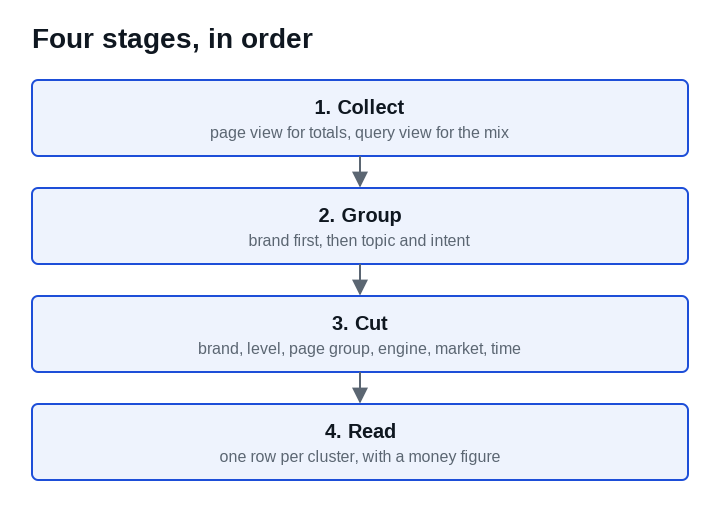
Collect: page view for totals, query view for the mix
- GSC and Bing first. Ranked queries show what actually brings traffic. Paid keyword tools come second, for demand the site doesn’t rank for yet.
- Use the page view for totals. The query view hides anonymized queries, so use it only to see which queries make up a page’s traffic.
| Source | Use it for | Watch out for |
|---|---|---|
| GSC, page view | click totals | nothing hidden |
| GSC, query view | which queries | totals 4x to 7x low |
| Bing Webmaster Tools | second engine | daily rows, add them up |
| Paid keyword tool | unranked demand | spikes, wrong-intent volume |
Group: brand first, then topic and intent
The usual order, going only as deep as the question needs:
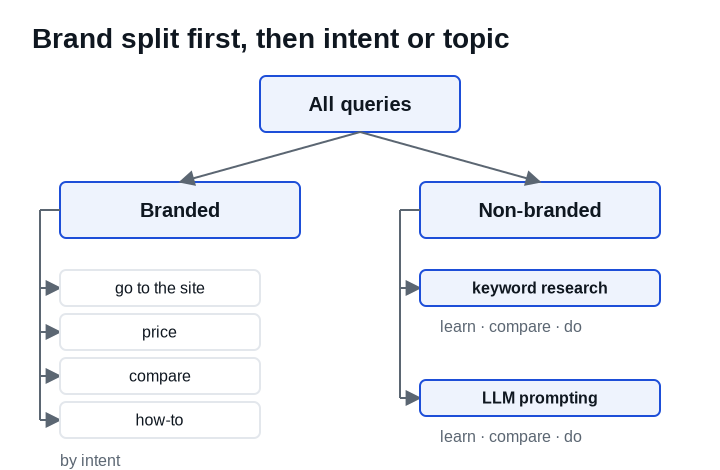
- Branded vs non-branded. Does the query name the brand? Keep the two apart in every report. The brand list includes typos of the name.
- Branded → by intent. Go to the site, price, compare, how-to.
- Non-branded → by topic, then intent. Topic first (keyword research, LLM prompting), then learn, compare or do inside each topic.
| Query | Brand? | Topic | Intent |
|---|---|---|---|
| brand a login | branded | none | go to the site |
| brand a vs brand b | branded | none | compare |
| cara riset keyword gratis | non-branded | keyword research | do |
| apa itu kgr | non-branded | keyword research | learn |
| contoh prompt seo | non-branded | LLM prompting | do |
Check for double meanings. On Site A, a big phrase with the product’s name in it was about a fashion accessory. Another meant an in-game item. Left in the brand cluster, they would have inflated brand demand.
Tag each cluster with its payoff, what it earns now that AI answers many queries. Clusters that only need an answer get judged on citations and assisted signups, never on click rate.
| Queries | Need | Payoff |
|---|---|---|
| cara riset keyword, riset keyword gratis | find keywords for free | click |
| apa itu kgr, kgr adalah | understand a term | answer |
| tools riset keyword terbaik | pick a tool | trial |
Cut: six ways to slice each cluster
Each cut can run inside the one before it:
| Cut | Values | Note |
|---|---|---|
| Brand | branded / non-branded | brand list includes typos of the name |
| Level | whole site → folder → URL | folder = first path segment |
| Page group | one URL, or a folder rollup | a rollup counts every URL under it |
| Engine | Google, Bing, AI assistant, other | from GA4 channel + source |
| Market | global, then ~7 country groups | Bing has no country data |
| Time | daily, weekly (Mon to Sun) | compare same-length windows |
Impact reports strip brand demand. They use the brand share of impressions as a ratio, because the query view undercounts.
Read: one row per cluster, with a money figure
- Group pages by folder or URL pattern, so each cluster is one row.
- Every row has a money figure and the rate behind it.
- Read signups by cluster, not traffic. On Site A, traffic followed audience size but paid signups followed category. Some categories brought traffic and no sales.
- Facts and guesses stay apart. “Clicks went 27 to 4” is a fact. “The results page changed” is a guess. A trend needs two dated data points.
- Flag small samples. A drop of 23 on a 27-click query matters more than a drop of 5 on a 5-click query.
| Cluster | Clicks (90d) | vs last 90d | Revenue, 90d (USD) | Rate used (USD RPM) |
|---|---|---|---|---|
| /guides/ explainers | 4,200 | +600 | 25 | 6 |
| /templates/ guides | 900 | −150 | 5 | 6 |
RPM is revenue per 1,000 clicks: 4,200 × 6 / 1,000 ≈ 25.
When a cluster’s clicks drop, check in this order. Each answer points to a different cause:
| Check | If it moved | Likely cause |
|---|---|---|
| 1. Position | fell | page lost relevance or rank |
| 2. Impressions | fell, position flat | Google shows the page for fewer queries |
| 3. Click rate | fell, both flat | results-page features or weak title |
Quick wins: non-brand clusters on page 1 with thousands of impressions and almost no clicks. The fix is usually the title and meta, not the body. Check the live title first, because often the new one never went live.
Deciding which clusters deserve a page is a separate step: see why most keywords don’t deserve a page.